

Popular Politics,
Populism & Democracy
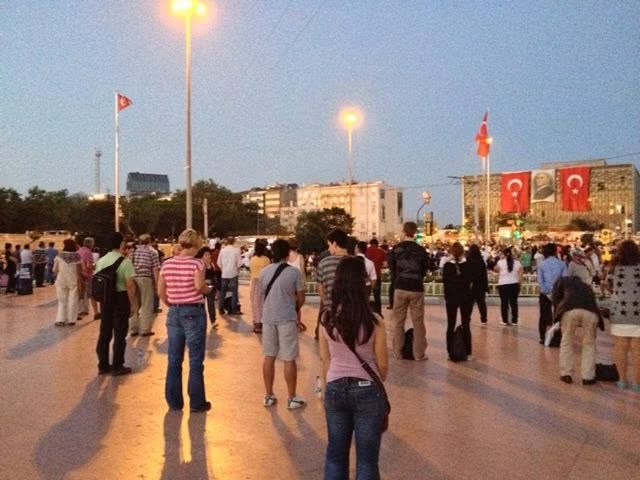
How do collective political subjects emerge, and how are claims to speak in their name articulated and contested?
My research in this area examines the constitution of ‘the people’ as a political subject and the relationship between popular mobilisation, populism and democracy. A central concern is how diverse social experiences, grievances and aspirations become articulated as expressions of a collective political will, and how particular actors acquire the authority to represent that will.
In Turkish Politics and ‘The People’: Mass Mobilisation and Populism (2022), I approach populism through a genealogy of the changing meanings and political uses of ‘the people’ in Turkey, from the late Ottoman period through the republican era to the present. The book examines how competing constructions of the people have informed political mobilisation, shaped institutional arrangements and defined the boundaries of legitimate political participation. It develops an understanding of populism as a political logic through which particular visions of society, sovereignty and democracy acquire force.
An important dimension of this work is the tension between claims to an undivided popular will and the institutional mediation of political differences. Populist projects can construct the people as a homogeneous and sovereign subject whose supposedly authentic will takes precedence over competing claims and intermediary institutions. This raises questions about the relationship between popular sovereignty and its populist appropriation, particularly when a movement or leadership claims to embody the people as a whole.
My more recent work develops these concerns by distinguishing between the popular, the populist and the plebeian. The distinction draws attention to forms of popular political agency that cannot be adequately understood through the conceptual vocabulary of populism alone. Plebeian politics emerges through challenges to established hierarchies, experiences of subordination and demands for political recognition. Its disruptive potential lies partly in questioning established distributions of authority and the boundaries of legitimate political participation.
Yet plebeian mobilisation does not necessarily follow a populist trajectory. A central question is what happens to plebeian demands when they encounter the problem of political organization and institutional mediation. Populist closure seeks to resolve political differences through an authoritative representation of the people as a unified subject. Plebeian-institutional articulation, by contrast, opens the possibility of translating challenges to established hierarchies into institutional arrangements without foreclosing further contestation. This distinction provides a way of examining the relationship between political rupture and democratic institutional life without assuming that popular mobilisation has a predetermined political destination.
Across these investigations, I am interested in the possibilities and limits of popular political agency, and particularly in the conditions under which collective mobilisation can challenge existing relations of power while sustaining democratic contestation.
Guiding questions
- How does a plurality of social experiences come to be represented as a single people?
- What distinguishes plebeian challenges to hierarchy from populist claims to exclusive representation?
- How can popular political demands find institutional expression without foreclosing further democratic contestation?